Skip to main content Skip to footer

The proposals

Consultation Document – Proposed introduction of a new Boat Safety Standard (and supporting Boat Safety Scheme Checks) for smoke alarms on boats

December 2025


Contents

Title Page

Consultation Document – Proposed introduction of a new Safety standard and supporting Boat Safety Scheme (BSS) Checks for smoke alarms on boats, Consultation date December 2025 - March 2026

Contents Page

Section 1 - Foreword and introduction

Section 2 - Background to the consultation

2.1    What role do smoke alarms have and why are they essential?

2.2    Why is a new Standard is being considered?

2.3    Risk arguments in favour the new proposals

2.3.1    Unseen and unnoticed causes of fires

2.3.2    Concerning the rapid development of fire

2.3.3    Concerning the spread of fire from source boats to other property

2.3.4    Responders can be at risk from fire on boats

2.3.5    The effectiveness of smoke alarms in detecting fire

2.3.6    Evidence of alarms being heard by people outside of the boat

Section 3 - Summary impact assessment

3.1    Intended objectives and benefits of introducing a new BSS Requirement

3.2    Potential unintended consequences and arguments against introducing the new proposals

3.3    What alternatives to introducing new BSS Requirements were considered?

3.4    The cost impact of introducing new BSS Requirements

3.5    The importance of fire safety awareness raising and other BSS activities

Section 4 - Your chance to comment on the proposals

4.1    Is the argument for the introduction of new BSS requirements supportable? (Q1)

4.2    Do you agree that the Checks A-D are supportable? (Q2-6)

Section 5 – About this consultation

5.1    How is the consultation to be run?

5.2    Have we been clear? Have we given you the proper opportunity and adequate means to contribute your views? (Q7). Do you agree that there are no unintended consequences concerning introducing the proposals? (Q8)

5.3    About you and your responses. (Q9-12)

5.4    Alternative means of submitting responses

5.5  Further information

Section 6 – Question & Response Form


The inland waterways Boat Safety Standards Setting Forum has launched a public consultation on proposals that have the support of its members comprising of representatives of navigation and harbour authorities, the marine industry body - British Marine, boat users and Boat Safety Scheme (BSS) Examiners. It also has the support of the BSS Advisory and BSS Technical forums and the BSS Board of Directors.

It is proposed to introduce a new mandatory Boat Safety Standard with related BSS Requirements for suitable smoke alarms in good condition and in suitable locations on all classes of boat with accommodation spaces.

Suitable smoke alarms are the readily available products that are currently third-party accredited as meeting BS EN 14604:2005. These are the alarms that are typically used in domestic buildings and are stocked by high street shops, in retail park stores and online retailers.

The changes are proposed for all types of BSS Examination, private boats, boats used for hire and other non-private boat classes.

The Forum believes that mandatory smoke alarms will help reduce the risk of fire spreading by giving an early alert to a fire starting and so allowing people to take harm-mitigating actions as soon as possible.

The early alert, when compared with not having an alarm, is predicted to allow some of the following measures (based on circumstances):

1) occupants to control a fire while it is very small – only if it safe to do so.

2) occupants to turn off emergency valves and switches

3) occupants to call emergency services earlier

4) people near the boat, to call the emergency services earlier

5) people to pull away adjacent boats and move any nearby objects at risk

6) warn occupants of neighbouring boats to exit and keep clear

7) greater time for crews to escape (additional first-party risk benefit)

The BSS proposals are presented as both necessary and proportionate risk controls and your comments upon them are welcomed. The consultation is open until 17:00 on Thursday 26 March 2026.

The proposed scope would not include open boats  nor those with accommodation spaces that are powered solely by a portable outboard motor (including petrol, petroil, diesel, LPG or electric power) and having no installed fuel system, and no installed electrical system(s), having no stowed spare fuel and having no fuel-burning appliances.

2.1 What role do smoke alarms have and why are they essential?

More on the causes of fire on boats and how to prevent it can be found at www.boatsafetyscheme.org/fire

2.2 Why is a mandatory new Boat Safety Standard (with corresponding BSS Checks) being considered?

The circumstances fall within the responsibilities of navigation and harbour authorities to have in place measures that protect waterways staff, neighbours, non-boating visitors and owners of other boats, from the risks present by the installation and systems found on a boat they allow to use their regulated waterway.

The proposals are based on risks, and patterns of risk, identified through the incident data the Scheme has collated, when and where it has been made available. They are supported based on information from fire and rescue services, the fire protection business sector, smoke alarm manufacturers and marine insurance.

The proposals have developed in collaboration with the BSS stakeholder organisations from the boat user, marine business, BSS Examiners, marine surveyors and navigation authorities

The reasoning behind the proposals is based on the following points

·       the risks of fire starting,

·       the causes of unnoticed boat fires

·       the rapid development of fire of boats

·       the frequency of fire to spread from a boat to another or spread from a boat to adjacent property and infrastructure.

·       the effectiveness of smoke alarms when installed on boats

·       the ability of alarms to prompt people to reduce harm to other people and property by:

o   the boat occupants, or people nearby, calling emergency services

o   moving adjacent boats and nearby objects at risk from fire

o   the boat occupants to escape a smaller fire before it develops

In these circumstances a mandatory new BSS Requirement is warranted, as contrasted with an ‘Advice check’ in a private boat Examination which relates to the first-party protection of the crew of the regulated boat only.

A detailed assessment of the risks was carried out through the BSS Risk Management Process.

2.3 Risk arguments in favour of the proposal

2.3.1 Concerning the causes boats to catch fire unseen and unnoticed

In the past ten years the BSS has recorded that 180 accidental boat fires have started with nobody aboard. (This does not include any fire where the cause equipment is unknown or not recorded)

BSS Examinations can reveal heat damage and scorching to boat structures, furnishings, cables and fuel systems where the damage is accessible to visual checking.

In the last decade, over 1100 boats have been found with signs of heat damage or scorching to various cupboard, furnishings, soft furnishing, wiring and system components. (BSS record for comments made against BSS Checks failing heat damage and scorching 2.15.2R / 8.4.1R / 8.4.2R / 8.5.1R / C7.13.9 / C6.7.1 / C6.6.1 between 01/04/2014-31/03/2024)

Such damage can also occur in hidden spaces and fittings, or at times when the installation or equipment is unobserved or unattended – including when people are asleep.

A typical example of this scenario featured in a MAIB report. A heater exhaust started, unnoticed, to char a wooden structure on a passenger transfer vessel serving a wind farm.

Another example is drawn from BSS records, on a liveaboard yacht, the owner lost his home when blankets stored in a locker where a small solid fuel stove flu-pipe was routed caught fire.

Just under 43 percent of fire incidents on BSS implemented waterways are linked to the use of solid fuel or oil-fired appliances where the cause is known and is accidental (2010-2024).

The insulation around electric cables can be worn away by vibration, causing shorts and sparks. Other electric equipment can fail unnoticed creating heat or sparks leading to ignition.

Fires from electrical sources are the second most common recorded cause of accidental fires on boats at around 25 percent of known accidental causes (2010-2024).

Unattended grilling or pans on hobs are another cause of boat fires, several have been fatal.

Portable heaters – spirit fuelled, running on gas or electrical also feature in the BSS fire records.

Solid fuel stoves that are unattended and stoves that have tile surrounds built out of unprotected combustible materials are further documented sources of fires starting unnoticed.

The BSS has noted that there is a growing number of lithium-ion rechargeable battery powered equipment under charge unattended.

While alarm industry representatives have stated to the Scheme that smoke alarms will not detect thermal runaway vapours/gases, but if fire starts, the smoke from any ignited combustible products should activate a smoke alarm of the type in the proposed standards.

We are aware of one lithium-ion thermal runaway event, where the smoke and carbon monoxide alarms were sounding on the boat prior to an explosion and fire, but this incident can only be considered as anecdotal, unless the BSS becomes aware of more evidence from other events.

2.3.2 Concerning the rapid development of fire on boats

The construction of boats results in them burning with speed and ferocity once fire catches hold. Whether they are steel boats lined with combustible materials, or fibre (glass) reinforced plastic (FRP/GRP) which burns readily, or traditional wood, they often contain soft furnishings, combustible accessories and fuels. We share three examples of many rapidly developing fires.

a. Marine Accident Investigation Branch (MAIB) report nb Lindy Lou 2007 https://www.gov.uk/maib-reports/fire-on-narrow-boat-lindy-lou-at-lyme-view-marina-adlington-england-with-1-person-injured-and-loss-of-1-life

Simple computer fire modelling conducted by Cheshire Fire & Rescue Service for a moderate fire within a compartment similar to that of Lindy Lou’s cabin adds weight to this scenario.

The model showed that after around 4 minutes the smoke layer produced by a moderate fire would have reached deck level, with temperatures in the area of around 200°C, and the fire constrained due to a lack of oxygen. Within a minute of oxygen being re-introduced to the compartment, the temperature would have rapidly risen to 600°C and flashover would have occurred.

b. Fatal fire in a cabin cruiser, the marina security camera footage was cited in a report provided to the inquest:

Ø  19:52:45 - Light within boat gradually dims. The fire may have started at this time, the smoke obscures light within boat interior.

Ø  19:56:41 - Fire increases in intensity and well-ventilated allowing it to develop more rapidly.

In the four minutes of these observations, the fire had become fully involved

c. MAIB report into a fire caused by an oil-fuelled heater on mv Topaz 7. https://www.gov.uk/maib-reports/fire-and-sinking-of-passenger-transfer-catamaran-ecc-topaz-during-engine-trials

MAIB Report on a fire involving the 14m passenger transfer catamaran Topaz. It states ‘The skipper noticed a small puff of smoke at 1245. The master of a dredger reported that he could see black smoke and flames on the north-east horizon at 1254…  …the [lifeboat] reached ECC Topaz at 1346 and saw that it was burning quite intensely. …. [at 1420] the burnt-out wreck sank in 33m of water.

The MAIB report noted “The heater space was not fitted with a smoke detector and therefore the skipper did not have any warning that a fire had started. Had he been alerted earlier, he could have taken steps to prevent the spread of fire. [2.4.1]”.

2.3.3 Concerning the spread of fire from source boats to adjacent craft and other property

The BSS reviewed its incident database for the 10-year period between 2014-2024. Across the UK and Ireland, the following has been recorded by the BSS

·       1308 - Fires on BSS implemented waterways, Non-BSS waterways and coastal waters

·       67 - Fires that led to further boats catching fire on all waterways (1 in 20 incidents of fire)

Focussing on BSS implemented waterways only, the following has been recorded:

·       737 Fires on BSS implemented waterways

·       41 - Fires involving more than one boat on BSS waterways (1 in 18 incidents of fire)

There are some more recent examples of damage caused by fire spreading from the source vessel.

In 2022 a GRP cruiser caught fire on a river navigation and set fire to a further two boats as it drifted downstream, then set fire to bankside vegetation followed by igniting trees and shrubs in the garden of a local residence and threatening the property before the fire and rescue service could bring the blaze under control.

A large GRP yacht caught fire in a coastal marina run by the local council. The authority was considering the impact of the blaze after the wooden pier was damaged. While the infrastructure was insured, in a ‘world of spiralling costs of building works and [challenges] getting contractors on site’, the authority was unclear how long it would take to have the facility available again.

It can be concluded that with around 5 percent of fires involving more than one boat, fire spreading is a risk. It is facilitated by allowing fire to develop, so the earlier a fire service can attend a fire incident, the risk of it developing and spreading to property beyond the boat is reduced.

2.3.4 Responders can be at risk from fire on boats:

Many people, including passers-by, neighbouring berth holders, volunteer staff and professional emergency service personnel put themselves forward to attempt rescue people or reduce the harm from boat fires when they occur. This is one illustration of the potential risks from an inland waterway’s incident in 2022.

‘A police community support officer risked his own life in an attempt to rescue a boater he thought was trapped when he was made aware of a boat on fire moored in a nearby marina.

He attempted to break entry to the boat to rescue the owner who he thought was inside (he was unaware at that point that the boat was empty). He continued to try to enter the boat until the fire became so fierce he was forced to stop.

The police officer continued to warn members of the public and other arriving officers to the dangers of any gas canisters exploding on the craft. During the incident, he inhaled a significant amount of black smoke and had to be taken to hospital for treatment.’

Early attendance by fire and rescue services to control a fire before it is fully developed can reduce the potential risks for first-responders getting harmed.

2.3.4 The effectiveness of smoke alarms in detecting fire:

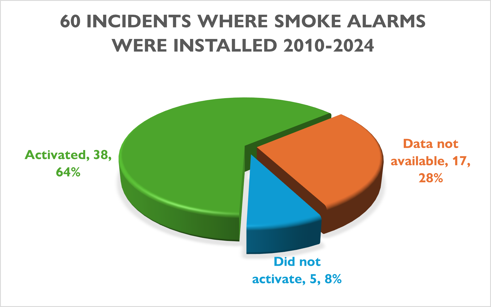
The BSS reviewed its incident data for the period 2010-2014. The Scheme has recorded that 60 boats involved in fire had smoke alarms. In nearly two-thirds of boat fire incidents where smoke alarms were recorded as being present, the alarm activated.While the Scheme has no activation data for around a quarter of the fires, it has recorded that the alarm failed to operate in only eight percent of fires on boats with smoke alarms. Pie chart showing a green 64 percent slice indicating 'Alarn activated' portion; an orange 28 percent slice indicating the 'data not available' portion; and a blue 8 percent slice indicating 'alarm did not work' portion..

The cause of the failure is not generally available, but various possibilities exist, including removed batteries, damaged units, and date expired products.

Campaigns to continue the routine and regular testing of smoke alarms by navigation authorities and the BSS are still to be a feature of the risk reduction processes.

2.3.5 Alarms heard by outsiders

The BSS reviewed its incident data for the period 2010-2015 to seek evidence that smoke alarms are both audible by people outside of the vessel where the fire is starting or developing, and that if the alarm is heard, people react in a helpful way.

To evidence this theory, we considered incidents where either or both smoke and carbon monoxide (CO) alarms have activated and been heard by people beyond the confines of the boat.

Both alarm types have the same required loudness level of at least 85 decibels (dB) at 3 meters, as mandated by relevant safety standards (like EN 14604 for smoke and EN 50291 for CO), the aim of the standards makers being that the alarms are loud enough to wake people from sleep, albeit the alarms may use different tones and patterns to distinguish between fire and carbon monoxide events.

While the BSS often finds detail of incident difficult to gather, it has identified at least ten documented incidents where either smoke or CO alarms were heard by people beyond the boat and their subsequent actions had a positive effect on the incident

Summaries

A fire and rescue service installed a smoke alarm on a boat on a canal, later the alarm activated awaking neighbouring boaters who called 999. Firefighters attended and extinguished a chimney fire. Burning carpet underlay set the poorly maintained chimney alight.

A narrowboat fire was attended by the fire service and quickly extinguished, limiting the damage to the boat. The owner was out and left the solid fuel stove running. Shortly after midnight customers at a nearby bistro heard an alarm sounding and after investigating the craft, they called both 999 and the boat’s owner.

Neighbouring berth holders heard an alarm sounding and contacted Maritime & Coastguard Agency who sent a vessel to investigate a fire on a boat in a marina. The cause of the fire was likely to be a light left on in the cabin with a short circuit.

Person walking past a friend’s boat, heard an alarm sounding (likely a CO alarm). Boat was locked with no one in sight. The passer-by made some calls and help arrived.

Drying clothing falling onto a woodburner caused a fire in a narrowboat moored in a marina. A neighbouring berthholder heard the smoke alarm and saw smoke. They called 999. The fire service attended and the fire damage was minimal.

A boater called 999 as she heard an alarm on a neighbouring boat but couldn't see if anyone was aboard. The fire crew cut the padlock off a door and found the boat was empty, but smoke was coming out of the solid fuel stove via a poorly fitting flue pipe.

A boat caught fire but escaped serious damage. as firefighters were called by a member of the public who responded to the boat's activated smoke alarm.

A CO alarm activated when a narrowboat was left unoccupied with the stove running with an open door. Neighbours heard the alarm and called emergency services in case there was someone aboard.

A fire crew attended a fire on a yacht in a coastal marina – the owner had left their hair-straighteners switched on while resting on a cushion for more than four hours. Neighbours heard the smoke alarm. An extinguisher successfully subdued the fire.

An electrical fire on a hire boat caused smoke and CO alarm activation. It alerted people nearby to the threats and they called fire and rescue service which arrived within a few minutes.

3.1 Intended objectives and benefits of introducing a new BSS Requirement

There are two intended objectives in the introduction of the proposed new BSS requirements.

Firstly, it is intended to help prevent the risk of fire developing and spreading to harm other people and property beyond the confines of the boat on which the fire started.

Secondly, even where a boat is isolated and the fire does not spread, the timely attendance of a fire crew can mean a boat remains floating with minimised damage, consequently it does not cause a hazard to navigation or a pollution threat for a time following the fire until removal of the wreck.

The key additional recognised benefits beyond the regulatory target are

a) the enhanced protection will also help protect the crew. We are not aware of any fatal boat fires where there was an alarm fitted or activated to alert the victim aboard

b) reduce the amount of damage a fire causes to the boat and allow it to be recovered and repaired.

In addition, we also believe it will help prevent harm from fire including fatalities and injuries to tenants, and others new to living aboard boats, who may be more exposed to this risk, perhaps through their lack of boat-dwelling experience, thus ignorant of fuel-related fire risks and lack of control over the maintenance and replacement of appliances.

Additional benefits beyond the regulatory intention

Based on the previous 10-year history of 13 boat fatalities (2014-2024), the overall effect is estimated that the next 20 years could see a reduction down to one fatal boat fires every ten years. This aspiration will be heavily dependent on the level of compliance with a new mandatory smoke alarm requirement and the effectiveness of associated additional support measures and partnership awareness-raising initiatives.

3.2 Potential unintended consequences of introducing the new proposals

The best protection for boaters is to prevent fire from occurring through the proper installation of appliances, good and regular maintenance and running them according to the instructions from the supplier. Smoke alarms do not align with this strategy. An alarm’s role is to provide an extremely critical backstop protection with robust method of detecting fire should it break out, making people aware of the fire and prompting relevant actions.

Boaters should also understand how to make and activate a fire action plan involving all crew members. Smoke alarms cannot be considered a primary form of protection, but as above they can act as a call to action to evacuate the boat, call for fire service help, evacuate the immediate surroundings, thus removing people and property from potential transmittable harm (radiated heat, fire and/or smoke).

However, a possible unintended consequence of the introduction of smoke alarms could be that the presence of alarms may cause a small minority of boaters to relax primary safety standards, as referred to above, and by inference, increase the risk of dangerous conditions occurring.

Additional factors that may lead to no reduced harm occurring, include:

·       boat crew/occupants’ failing to act appropriately upon an alarm activation;

·       incapacity through drugs or alcohol;

·       failure to replace an alarm when damaged and/or at life expiry or battery expiry;

·       installing an inappropriate, poor quality or non-functioning alarm.

3.3 What alternatives to introducing mandatory new BSS Requirements were considered?

Introduce BSS ‘Advice Checks’ advice checks are considered inappropriate because the circumstances fall within the criteria for mandatory compliance, i.e. reducing the risk of the spread of fire for the protection of people outside the boat.

Do nothing – considered but rejected as the recently collected evidence that went through the BSS Risk Review and Assessment process is compelling and the BSS and Navigation Authorities would be exposed if they disregarded evidence, and if the BSS failed to take account of advice from its stakeholders and competent advisors who fully support the proposals.

Rely only upon safety awareness campaigns - Reliance upon co-ordinated campaigns aimed at raising awareness is not considered a fully effective strategy. Research by the BSS based on field observations of voluntary smoke alarm installation (Sep 21-Sep 22) showed that nationally, only 46% of boats had working smoke alarms. (Canal river Trust 53%, Environment Agency 25%, Broads Authority 23%) there are links to more detail on this web page www.boatsafetyscheme.org/about-us/consultations-reviews/smoke-alarm-surveys//

There had been a robust campaign for voluntary carbon monoxide (CO) alarm adoption in the decade leading up to 2019. In April of that year the mandatory requirement for CO alarms was introduced by the BSS and CO alarm adoption rose from 68% to 92% within two years.

Further compliance options: consideration was given to including heat alarms third-party accredited certified as meeting BS 5446-2:2003, as a potential alternative to suitable smoke alarms.

We consulted on this possibility with the National Fire Chiefs Council (NFCC) and Fire Industries Association (FIA).

The view of NFCC is that heat alarms are recommended in the galley for added protection but should not be regarded as a direct replacement for smoke alarms. The FIA also endorses the NFCC advice to fit a heat detector in the galley area of boats as guidance.

There is further information on why heat alarms are not considered to in section 4 of this document.

In conclusion, the option to introduce mandatory new BSS Requirements is the proportionate means to address the risk of fire spreading and has full stakeholder support and is the sole recommendation presented.

3.4 The cost impact of introducing new BSS Requirements

The following assumptions are presented:

a.       Approximately 90,000 boats are subject to the BSS in any four-year period. Extracting the numbers of hire boats and non-private boat classes (combined 3,100) So, based on a national average as found by the BSS in its survey on the use of smoke alarms in boats, there will be of 52% of 86,900 boats in scope having no suitable smoke alarm in good condition installed. This equates to 45,188 private boats affected.

b.       Note: the figure of 52% accounts for 2% (1800) of boats had alarms but were not working. We have no indication as to the reason the alarm failed to work when tested, such as the battery being disconnected, or the whole unit not functioning and needing replacement. But we will assume the majority only require battery replacement at minimal cost.

c.       Assuming each alarm costs £15 inc. VAT, at least one-third of the 27 optical smoke alarms certificated to BS EN 14604 with a 10-year life, or 10-year warranty were for sale at £15 or under in a BSS survey of six high-street, trading estate and online retail suppliers in December 2025. While not included in the survey, twin and multiple alarm packs reduced the unit cost.

d.       One alarm is generally sufficient to meet the BSS minimum safety requirement. However, two or more may be required if separate accommodation spaces are separated by doors and are more than 10m from an alarm.

e.       Each sealed lithium battery alarm will have a lifespan of seven to ten years dependent upon battery health. Devices using replaceable batteries generally have a ten-year lifespan (Sources: Cheshire Fire & Rescue, Safelincs, First Alert, Fire Angel).

f.        No installation costs are taken into account because the securing options from small screws to sticky pads are relatively minimal.

g.       The estimated 46% of boats with existing smoke alarms will likely have alarms compliant with the proposed new BSS requirements. A further 2% of non-working alarms will need batteries installing.

h.       The proposed new BSS Requirements will follow most of the criteria of the existing hire boat requirements for smoke alarms for craft with overnight accommodation, namely:

      Smoke alarms must be supported with a certification of an accredited certification body to BS EN 14604:2005 or equivalent.

•      Alarms must be provided with a test function button.

•      Alarms must be in good working condition

The following costs are estimated:

a)         The following scenarios are based on a reasonable estimation on the lifespan of a smoke alarm. The model is based on a domestic alarm with a warranted 10-year lifespan. The alarm manufacturers have advised that an alarm may not last the claimed lifespan due to the more challenging environmental and operating conditions found aboard boats. Therefore, in this section, we are using the estimated lifespan of seven years.

Additional costs to boat owners/operators - £677,820 (45,188 boats x £15 each boat), this also equates to an average outlay of £2.14 per year per boat, over a seven-year lifespan of the alarm.

Focussing on hire operators specifically, it is estimated that there are currently around 2400 boats registered for weekly hire, which are already required to have smoke alarms. There will likely be an estimated 240 day-hire boats (10 percent) with cabins, not already having smoke alarms, brought into scope £3,600 (240 x £15 each boat), this could equate to a new outlay of £2.14 per year per boat over seven years.

Additional costs to the owners of other classes of non-private boats subject to the BSS. These are the workboats, hotel boats, floating cafes, etc, estimated at around 700 boats. It is estimated that smoke alarm uptake will likely be already high in this class, so we make an assumption that two-thirds of the non-private fleet already have smoke alarms installed.

The total fleet cost is estimated at £2,935 (233 x £15 each boat), which equates to a new outlay of £2.14 per year over seven years.

b)         Will there be additional BSS Examiner charges for their boat owners/operator customers? – it is possible that examiners will charge more for the added time taken to carry out the additional checks. Examiners operate in a free market regarding their charges. However, the extra time taken to conduct the proposed checks is minimal.


c)         Additional costs to the BSS – no additional costs, only normal operating costs in support of consultation, implementation, promotion and review.

d)         Additional costs to BSS Examiners – it is intended that training to the proposed new checks will take place online. As such any training costs will be minimized for BSS Examiners.

e)         Additional cost to navigation authorities - Direct cost to the Navigation Authorities may arise for amending registration, licensing or other conditions and any information to reflect the change in requirements.

3.5 The importance of fire safety awareness raising and other BSS activities

The Scheme is keen to stress that its proposal to introduce a Boat Safety Standard (supported by new BSS Requirements) for smoke alarms on all classes of boat with accommodation spaces should be seen in a wider context of other related activity that will be taking place, often with the assistance of strategic partners.

Clear guidance and safety awareness information remains paramount. In the event of a successful consultation, initial messages will emphasise:

·     the recommended types of smoke alarm, and

·     where to fit them will be promoted, and

·     the importance of pushing the test-button routinely, and

·     the actions to take if the alarm activates, and

·     the need to make a fire action plan

·     the need to know how fire extinguishers should be used and when not to use them

The navigation and harbour authorities together with the BSS will continue to support partnership initiatives aimed at influencing behaviour concerning the selection, maintenance and use of appliances.

The focus will be on fire safety awareness efforts targeted towards those boaters considered to be at heightened risk, i.e. ‘hard to reach’ vulnerable live-aboard boaters and those that are boat users who are new to boating and may or may not fall into the vulnerable category, but who may not have a full understanding of the risks.

Acting on the navigation and harbour authorities’ behalf, the BSS will promote through British Standards Institution committees, a policy for smoke alarms to feature within a relevant clause of the Recreational Craft Regulations supporting standards.

Our aim will be to share as we learn and hence drive safety forward through a constant improvement process.


4.1       Is the argument for the introduction of new BSS requirements supportable?
Question Q1 – This question will ask if you support the general concept of introducing a new mandatory safety standard for the correct number of suitable working smoke alarm(s)?

From our experience of mandating of CO alarms in 2019, we know that the ongoing maintenance and upkeep of alarms that have been enforced through a regulatory process may not be as strong as those voluntarily installed. However, mandating smoke alarms will address those boaters who have an attitude to safety that is otherwise difficult to influence. As mentioned previously, we saw a 30-point rise in the presence of CO alarms on boats within 12 months.

Also, on the topic of behavioural insight, anyone who unadvisedly uses a smoke alarm as a primary protection device instead of making their system safe, will still have at least some level of protection, albeit limited to the last level and potentially increased risk.

However, the proposals support the view that there are compelling reasons for introducing mandatory new BSS Requirements for suitable smoke alarms in good condition and in suitable locations on all classes of boat with accommodation spaces. The aim being to help restrict the spread of fire and help reduce the potential for harm to people and property by instigating an earlier action to reduce the effects of the fire.

We would like you to express your views.

Note: Why heat alarms are not included in the proposed Standards

Heat alarms are not acceptable as a substitute for smoke alarms in the BSS Requirements. Smoke alarms work by detecting particles of smoke.  Heat alarms work by detecting very high temperature in a room and are less sensitive than smoke alarms. This is based on advice from the alarm manufacturing sector, however they recommend heat alarms as a useful addition to smoke alarms in smoky or steamy rooms like a kitchen or bathroom.

Because the proposed new requirements are based on providing the earliest possible alert to mitigate the risk of fire spreading, heat alarms are not the best option so the proposals are that they will not be included in the mandatory complement of alarms.

If found by Examiners they will be ignored and not included in the test procedures. The new standards will allow heat alarms to remain in place, to be replaced and new ones to be provided. Put simply, the BSS Examination will be blind to their presence, and they will not be counted as contributing to complying with the proposed Standards.

4.2       This concerns proposed changes to the BSS Examination Checking Procedures to support the proposed new Standards i.e. how the compliance with the standards will be expressed.
Questions Q2-Q6 – We will ask whether you agree that the Checks A-D and the proposed amendments to Appendix 6 are supportable?

Proposed new BSS ECP Section 6.5 Smoke alarms

The existing Hire Boat Requirements smoke alarm check X10.8.1R is being removed from section 10.8. It is proposed to be replaced by the new Checks at section 6.5 in the core BSS Requirements, which also apply to Hire Boats.

X10.8.1R is a multifunctional check covering provision, location, audibility, and suitability. In the proposed new section 6.5, these points have been split across four checks to help identify any specific non-compliant features and this in turn will facilitate a more detailed rectification comment, as well as provide the BSS and navigation authorities with more accurate metrics on non-compliance subjects.

Proposed BSS Check 6.5.1

This Check is a simple verification that at least one suitable smoke alarm is present. The audibility, suitability, quality, location, and condition of alarms are covered in the other three checks.

Accommodation space definition: In the BSS Examination Checking Procedures Glossary it is; ‘Space surrounded by permanent boat structure in which there is provision for any of the following activities: sleeping, cooking, eating, washing/toilet, navigation, steering. Spaces intended exclusively for storage, open cockpits with or without canvas enclosures, and engine rooms are not included.’

6.5.1

If the vessel has one or more accommodation space(s), is at least one suitable smoke alarm provided?

R

Identify the presence of one or more accommodation space(s).

If present, check for the presence of smoke alarm(s).

All vessels with one or more accommodation space(s) must be provided with at least one smoke alarm.


Proposed BSS Check 6.5.2 (below)

This concerns the audibility of the alarm for the craft occupants i.e. for occupants own safety. This means it is a first-party risk for private craft and therefore it will be an advisory BSS Check in BSS Examinations on private boats and identified by the suffix A.

However, for Hire Boat Requirements and Non-Private Boat Standards, the increased duties of care mean that this Check has the suffix R and is a mandatory compliance.

6.5.2 /

X6.5.2 / C6.5.2

If the vessel has accommodation space(s) used for overnight stays, are the correct number of smoke alarms provided?

A / R / R

Check for the presence of accommodation space(s) that can be used for overnight stays.

If present, check by visual assessment and, if necessary, measure the distance between smoke alarm(s) and each accommodation space that can be used for overnight stays.

A smoke alarm must be fitted within 10m of each accommodation space that can be used for overnight stays.

Applicability – on boats used for private pleasure purposes the presence of berths shall be taken as evidence that an accommodation space can be used for overnight stays.  On hire boats, where not self-evident, Examiners must establish from the hire operator whether the boat is let out for overnight stays.


BSS Check 6.5.3R (below)

This proposed check covers the mandatory BSS Requirements and navigation authority standards for: -

·       the assurance of the alarm’s design and production standards,

·       its functionality and

·       its mounting specification that supports its effective detection of smoke

By meeting these points, it should assure the navigation authority smoke alarm is likely to work, being placed in an appropriate location, being of a certified quality, and capable of being tested.

6.5.3

Are smoke alarms of a suitable type and located at high-level?

R

Where one or more smoke alarms have been found to be necessary at Checks 6.5.1 and/or 6.5.2, check the location of each required alarm.

Check the markings on each required smoke alarm.

Identify the test function button on each required smoke alarm.

Smoke alarms must be marked as being certified by an accredited third-party body to EN 14604 or equivalent.

Smoke alarms must be provided with a test function button.

Smoke alarms must be ceiling-mounted or wall-mounted between 150mm – 300mm below the ceiling height.

Applicability – in the event a boat is fitted with a permanently installed smoke alarm or other detection device that is not marked as being certified by an accredited third-party body to EN 14604, the Examiner should contact the BSS Office for guidance.

Applicability – the main accredited third-party certification bodies in the UK are British Standards Institution (bsi) and Loss Prevention Certification Board (LPCB). For the following makes of smoke alarm third-party accreditation can be assumed - BRK, Dicon, Ei Electronics, Fire Angel, FireHawk Alarms, First Alert, Honeywell and Kiddie.  For other makes, removing the alarm from its base may be necessary to view labels and approval marking on the base.  Permission for removal should be sought from the  owner, owner’s representative, or operator.  Documentary evidence of accredited third-party accreditation is acceptable.

Applicability – Smoke alarms may be wall mounted outside of the range specified in the requirement (…. between 150mm – 300mm below the ceiling height) where any such alternative location is permitted by the alarm manufacturer and where appropriate supporting documentary evidence is available. 

Applicability – In cases where alarms are mounted outside of the range specified in the requirement, examiners are recommended to make a note of the alarm make and model and the supporting documentation in their field notes.

Guidance for owners – ‘optical’ alarms are the best choice for boats. They are more effective at detecting slow-burning fires and are less likely to alarm falsely.

Guidance for owners – for addition assurance consider installing a heat alarm with accredited third-party certification for meeting BS 5446-2: 2003 in the galley area.

Guidance to owners – Ensure you have a fire action plan so all crew members know what to do should the smoke alarm activate.

Supporting information on accredited third-party certification is provided at Appendix 6.


BSS Check 6.5.4R (below)

This is a proposed condition requirement identified to help ensure the alarm is in a working condition and, has the best chance of effectively activating when needed.

6.5.4

Are smoke alarms in good condition?

R

Where one or more smoke alarms have been found to be necessary at Checks 6.5.1 and/or 6.5.2 visually check the condition of each required smoke alarm, and operate the test function button on each alarm.

Smoke alarms must be in good general condition, and must not show signs of any of the following indicators of poor condition:

·   damage or deterioration to the body of the alarm or the fixing mechanism;

·   having passed any manufacturer’s express replacement date;

·   failing the test function check.

Applicability – Examiners are not required to open up alarms to check for internal damage or deterioration or for manufacturer’s express replacement dates.

Applicability – if any smoke alarms have a manufacturer’s label stating, for example, ‘Replace 10 years after installation’ and if the installation date has not been added to the label, then the express replacement date should be taken as 10 years after the stated manufacturing date.


BSS Examination Checking Procedures Appendices – proposed amendments to Appendix 6 Section 1 – Alarms in support of the proposed new smoke alarm checks.

We show that the information appendix 6 section 1 can support the required advice, information and instruction for both CO and smoke alarms

1.2 Emergency escape and alarms – essential material – understanding the ECP Glossary term ‘accommodation space’

To be able to apply the Checking actions at Checks 6.3.1, and sections 6.4 and 6.5 in a robust and consistent manner Examiners must be able to recognise accommodation spaces.

ECP Glossary term - Accommodation space

“Space surrounded by permanent boat structure in which there is provision for any of the following activities: sleeping, cooking, eating, washing/toilet, navigation, steering. Spaces intended exclusively for storage, open cockpits with or without canvas enclosures and engine rooms are not included.”

Therefore, each individual space within a boat completely surrounded by permanent boat structure, and where there is provision for sleeping, cooking, eating, washing/toilet, navigation, or steering, is an individual accommodation space.

In the context of accommodation spaces, movable flexible screens/curtains/hoods are not permanent boat structure.

Wheelhouses - wheelhouses completely enclosed by permanent boat structure are accommodation spaces, but wheelhouses with canvas-type screens/curtains, and cockpits with canvas-type hoods are not accommodation spaces as such movable flexible screens/curtains/hoods are not permanent boat structure.

Individual passageways - individual passageways completely surrounded by boat structure are not accommodation spaces unless there is provision for sleeping, cooking, eating, washing/toilet, navigation, or steering within the passageway.

Engine rooms - engine rooms are not accommodation spaces however they are configured (e.g. even walk-through engine rooms are not accommodation spaces in the context of the BSS Requirements).

1.3 Carbon monoxide (CO) and smoke alarms – essential material – measuring the distance between an alarm and any door that links accommodation spaces

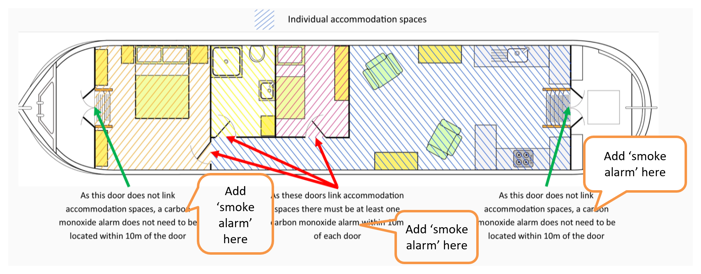
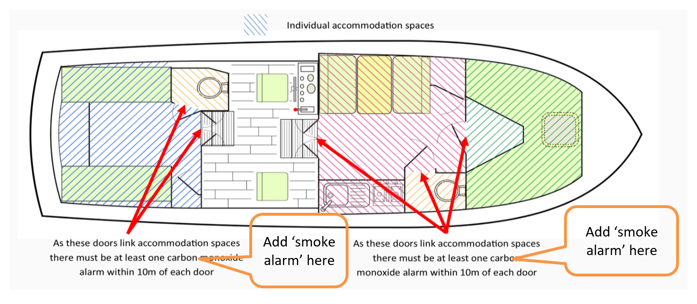
The Requirements for CO and smoke alarms at Checks 6.4.1 and 6.5.2 specify that on boats with two or more accommodation spaces, any alarm must be located within 10m of any door that links the accommodation spaces. 

Where there are a number of accommodation spaces (e.g. separate cabins) the sound of an alarm will be deadened by the separating boat structures including closed cabin doors. 

By requiring an alarm to be located within 10m of each door that links accommodation spaces there is an assurance that wherever someone is located within the interior of a boat they are likely to be able to hear an activated alarm.

In the context of Checks 6.4.1 and 6.5.2, ‘links’ means that the door can be used to gain access to another accommodation space, even though the two accommodation spaces may not be immediately adjacent, or directly connected, to each other.

The following two diagrams help explain the distance measurement Requirements for different accommodation space configurations –

Text Box: Fig 1.  To be compliant at Checks 6.4.1 and 6.5.2, CO and smoke alarms must be located within 10m of the three doors that link accommodation spaces.

Speech Bubble: Rectangle with Corners Rounded: Add ‘smoke alarm’ hereSpeech Bubble: Rectangle with Corners Rounded: Add ‘smoke alarm’ here

Text Box: Fig 2.  To be compliant at Checks 6.4.1 and 6.5.2, CO and smoke alarms must be located within 10m of the five doors that link accommodation spaces. In this example the cockpit/wheelhouse is not an accommodation space, but the two companionway doors do link to other accommodation spaces (the aft cabin’s companionway links to the main cabin, and vice versa).

1.4 CO and smoke alarms – essential material – accredited third-party certification marks

The principles behind the certification of CO and smoke alarms are the same as those for portable fire extinguishers. 

In the UK the main accredited third-party certification marks likely to be found on CO and fire alarms are those of the British Standards Institution (bsi) and the Loss Prevention Certification Board (LPCB).

However, UL International (UK) Ltd is also recognised as an accredited certification body in respect of the certification of CO alarms to BS EN 50291, and as such its mark may also be found on suitableCO alarms.

Ei Electronics utilise accredited certification body VdS Schadenverhütung GmbH to certify some of its smoke alarm models.

The VdS laboratories is accredited for smoke alarms to EN 14604 by the national Accreditation Body of Germany (DAkkS). As VdS also certify a range of German smoke alarms and so the VdS mark is included as an accepted accredited third-party certification body mark.


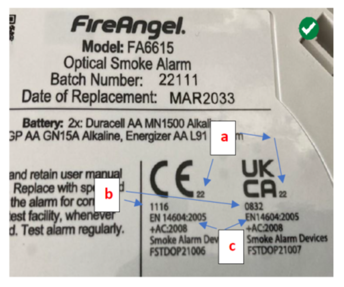
In general terms, the CE mark or UKCA mark on a product does not amount to proof of accredited third-party certification.

For smoke alarms the situation is different because the CE/UKCA mark is likely to relate to the Construction Products Directive and/or Regulations and the route to accredited certification is identical to that associated with the BSI or LPCB marks. Most alarms will still display the BSI or LPCB mark, however a few models will be solely CE/UKCA marked. 

The photo is of the underside of FireAngel optical smoke alarm model FA6615.

According to the second Applicability of the Check, FireAngel smoke alarms are always acceptable, however BSS Examiners can accept any make of CE/UKCA marked smoke alarm where:

a)        the CE mark and UKCA mark is immediately followed by the two last digits of the year the mark was first affixed (22 = 2022); and,

b)        a four-number code of a Notified Body is located under the CE or UKCA mark; and,

c)         there is a reference to the European manufacturing standard EN 14604.

Other certification body marks may be acceptable, but Examiners should contact the BSS Office for confirmation of acceptability if other marks are found.

Because the following companies only make CO alarms to BS EN 50291, and smoke alarms to BS 14604 and because all their alarms are certified by an accredited third-party certification body, Examiners are not required to establish the accredited third-party certification mark on CO and smoke alarms made by the following companies:

·       BRK

·       Dicon

·       Ei Electronics

·       FireAngel

·       Firehawk

·       First Alert

·       Honeywell

·       Kiddie

5.1           How is the consultation to be run?

We hope this consultation is of interest and well-presented so that you can understand and give due consideration to the various issues, the risks and the benefits.

The consultation is open until 17:00 on Thursday, 26 March 2026. With the launch of the consultation on Wednesday 31 December this provides an 84+-day period of consultation.

If you have trouble with the consultation form or a related query, please email the Standard Setting Forum secretariat at bss.enquiries@boatsafetyscheme.org

We will produce a summary of the views expressed and our response within two months of the closure of the consultation. This will be published on the BSS website www.boatsafetyscheme.org/about-us/consultations-reviews/

If there is demonstrable support for the proposal, a communications campaign will promote the final agreed changes from Spring 2026.

New Boat Safety Standards (with supporting Boat Safety Scheme Checks) for smoke alarms are intended to come into effect from 1 October 2026 by which time, BSS Examiners will have completed familiarisation training modules.

The six-month period should also be sufficient, for boat owners and operators to obtain and install suitable working smoke alarms in the boats they own and or operate.

Boats with existing BSS Certifications will not be required to obtain a new Examination and Certification because of the implementation of any new smoke alarm requirements. However, any boat in scope will be expected to comply with any and all new smoke alarm requirements by the date of implementation, should new smoke alarm safety standards come into force.

Your opinions are valuable to us. Thank you for taking the time to read this document and respond.

5.2       Your opportunity to comment on this consultation.

Question Q7 – Have we been clear? Have we given you the proper opportunity and adequate means to contribute your views?

Your views are invited on any intended or unintended consequences (Q8) concerning introducing a specific proposal or on the generality of these proposals.

Question Q8 – We ask if you see any further unintended consequences concerning introducing the proposals beyond those already mentioned in this consultation?

5.3       About you and your responses.

When we publish the results of this consultation, we would like to be able to refer to those organisations responding and possibly quote from the comments made. Providing answers to Questions 10 – 12 will provide detail that will help us analyse and handle your responses.

Question 9 – Please tell us your name and indicate your sector of interest (for example boat owner, hire boat operator, navigation authority, marine trader, BSS Examiner, if other please state).

Please let us know if you are responding as an individual or on behalf of a company, representative group or commercial/non-commercial organisation.

This will help people appreciate your response in context.

Question Q10 – If responding for an organisation, may the organisation’s name and its response be made public?

This will help people appreciate your response in context.

Question Q11 – If you are an individual respondent, are you happy for your anonymised responses to be made public?

If we can, we publish the responses, where space allows. We may collate responses and provide one reaction to a collection of comments of a similar nature.

Question Q12 – Considering your responses, do your responses/comments relate to any particular area of the inland waterways? It would be helpful if you would select one of the following navigation authorities.

Your personal data will only be disclosed to the Boat Safety Standards Setting Forum secretariat at the Boat Safety Scheme Office and the consultants facilitating the consultation website.

Individual responses will only be acknowledged by an on screen message and automated email, unless you request a specific response.

If you want the information that you provide to be treated as confidential, it would be helpful if you could explain to us why you regard the information you have provided as confidential.

5.4           Alternative means of submitting responses

The preferred method for responding is to use the BSS website www.boatsafetyscheme.org/ Alternatively, you can email your responses to Questions 1-12 (below) to the BSS Secretariat at this email address BSS.enquiries@boatsafetyscheme.org or upload a completed document using the contact us web page form on this link www.boatsafetyscheme.org/contact-us/

If you prefer to put your comments on paper, you can send them to:

Boat Safety Standards Setting Forum Smoke Alarm Consultation

c/o Boat Safety Scheme Secretariat,

National Waterways Museum Ellesmere Port,

South Pier Road,

Ellesmere Port

Cheshire CH65 4FW

If you have alternative access requirements for any element of the consultation process, please call or contact us by phone, email or the contact form www.boatsafetyscheme.org/contact-us/ .

5.5           Further information

Should you have any questions about this consultation and how to respond, please contact the BS SSF Secretariat at BSS.enquiries@boatsafetyscheme.org or call 0333 202 1000.

If you have any complaints or comments about the consultation process please direct them to the BS SSF Secretariat at BSS.enquiries@boatsafetyscheme.org or use the contact form www.boatsafetyscheme.org/contact-us/ or write to the address above.